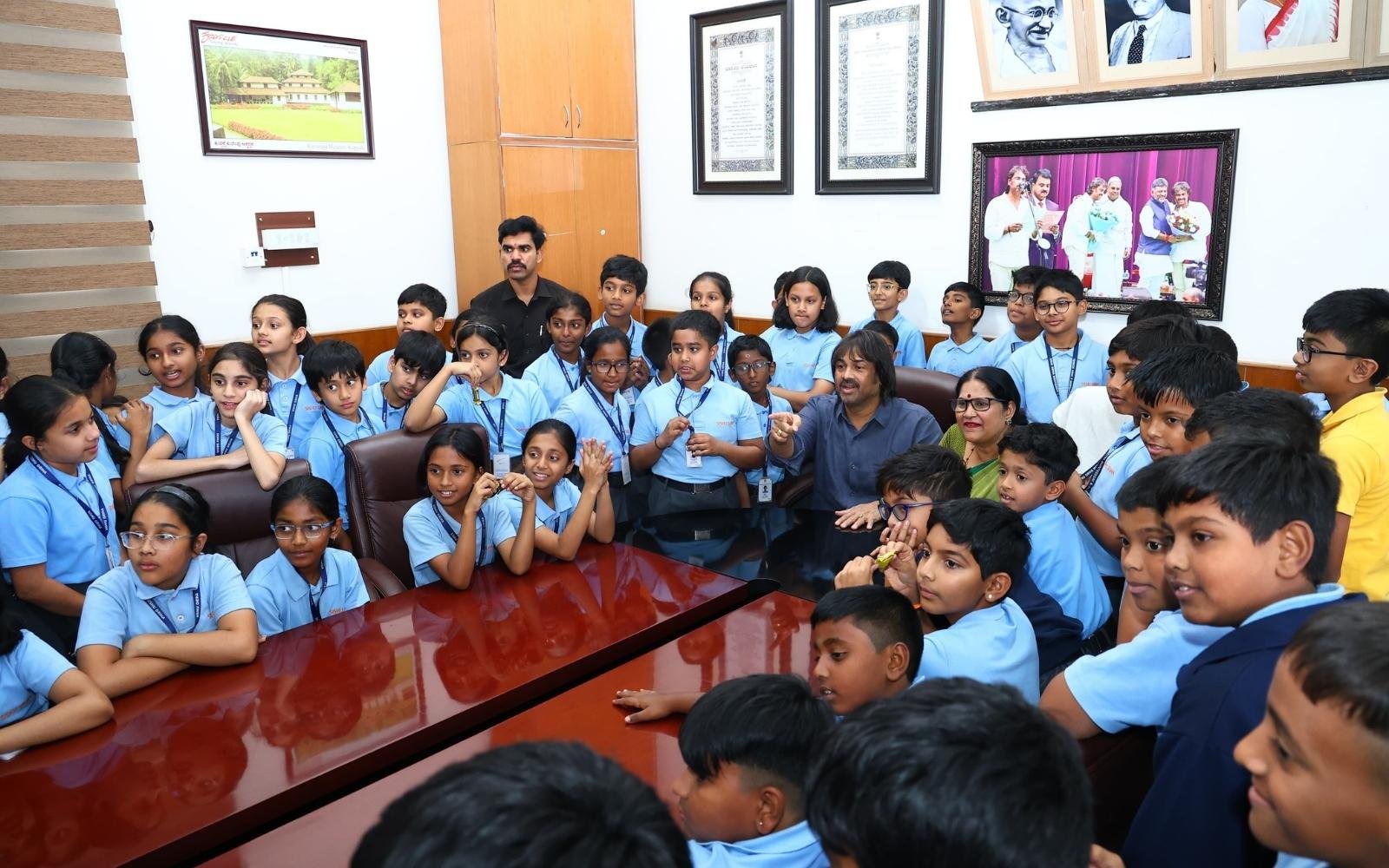
There is no rule that a revolution must always involve slogans. Sometimes, big changes begin very silently. The Karnataka Public School (KPS) project currently taking place in Karnataka is one such silent revolution. Specifically, the project of constructing and upgrading around 800 Karnataka Public Schools in the Kalyana Karnataka region is not merely a program to build new buildings. This is an ambitious effort to change the social and economic future through education. The government is progressively developing 800 schools into Karnataka Public Schools at a cost of around ₹3,900 crores, aiming to provide quality education from L.K.G to Second PUC within a single campus.
Kalyana Karnataka has historically been recognized as a backward region in many sectors. Education was no exception to this. In many villages, it was common for the primary school to be in one place, the high school in another, and the PU college in yet another village. Because of this, children from poor families, girls, and rural students were forced to drop out of education midway. The Karnataka Public School model aims to provide a permanent solution to this problem. Since continuous education from LKG to PUC is available on a single campus, the occurrence of students discontinuing their learning journey midway will reduce.
To understand the importance of this project, we must not look at buildings alone. A good school means good teachers, science laboratories, libraries, sports facilities, digital classrooms, a safe environment, and an atmosphere that nurtures children’s dreams. This is exactly the objective of Karnataka Public Schools. Its core principle is that children should get the same quality of education in government schools that is available in private schools.
This project is even more special for Kalyana Karnataka. In this region, more than 200 Karnataka Public Schools are being developed in collaboration with the Kalyana Karnataka Region Development Board. More schools will be added in the coming phases, and thousands of rural families will directly benefit from this. By investing crores of rupees in each school, infrastructure, new classrooms, modern learning facilities, and a student-friendly environment are being created.
But buildings alone do not change education. That is why the Government of Karnataka has undertaken several fundamental reforms to enhance the quality of education. Measures such as appointing one teacher per class at the primary level, subject-expert teachers in higher classes, opportunities to learn in both English and Kannada mediums, introducing digital and artificial intelligence at the initial stage itself, and giving greater emphasis to art, sports, and vocational education are further strengthening the Karnataka Public School model.
According to my belief, equal opportunity in education is true social justice. A child from a village in Kalaburagi, Bidar, Yadgir, Raichur, Koppal, Vijayanagara, or Ballari should get the same quality of education as a child studying in an excellent school in Bengaluru. The place of birth should not determine opportunity. Talent has no boundaries. Opportunities too should have no boundaries.
Another major objective of this project is to increase the confidence of parents in government schools. In the past few years, a trend of moving from government schools to private schools has been observed. But when good infrastructure, quality teachers, and a modern learning environment are created, people’s faith will return to government schools. It is not just about increasing enrolment numbers; it is a step toward re-establishing trust in the government education system.
The Karnataka Public Schools we are building today are education centers being designed for the next ten or twenty years. Doctors, engineers, teachers, scientists, agro-entrepreneurs, athletes, and responsible citizens will emerge from these. Every school has the power to change the future of a village.
I always say only one thing. If you build roads, villages get connected. But if you build schools, generations get connected. This journey of Karnataka Public Schools in Kalyana Karnataka is not just a project of the Education Department. This is a social movement that gives new self-confidence to a region that lagged behind due to a lack of opportunities. Today, this may look like a silent revolution. But tomorrow, its result itself will write a new chapter in the development of Karnataka.